For what? The 12 (or 11 by some counts) Mustang A/FX Funny Cars were delivered with HP engines that were pulled and replaced with 427CID monsters.
Jim
(Fixed a spelling error.)
For what? The 12 (or 11 by some counts) Mustang A/FX Funny Cars were delivered with HP engines that were pulled and replaced with 427CID monsters.
Jim
(Fixed a spelling error.)
Semi-gloss black rattle-can from your favorite hardware store works as well as anything from Eastwood. Face it, your car will not sit in the rain after you are done with it - will it?
Jim
Orange peel is a "clumping" of paint usually in an area where too much has been sprayed and it looks like the surface of an orange. My 65 and 66 Fastbacks have it around the vents. The factory allowed a certain amount as acceptable, as does MCA. It takes a real good painter today to duplicate it. The paint back then was enamel.
Jim
Sorry to burst your bubble, but that is a record made by a California band (and yes, I do have an original LP copy), published by a California Company (A & M Records), and as screwed up as California is, produces more dairy products than Wisconsin. We have to, we got eight times the population.
Jim
For the most part they are drawings, no photographic quality pictures. I'll send you a copy of one page of the 66 body manual for you take a look at. Sorry, I don't have any electrical pages scanned but the instrument cluster drawing shows the entire associated wiring, routing and hardware.
Jim
 Quote from CharlesTurner
They're not required for concours judging, but if they are installed, they have to be the correct finish with correct hardware.
Being that the tie down plates are a "reused" part, have little if any documentation and were installed with what hardware was available, scratches, rust and mismatched hardware would be the norm for factory installed items. That being said, I would recomend that if installed, the associated items be "clean" at the least.
Jim
I recomend you get a set of the Jim Osborn produced Mustang Assembly Manuals for your year car. Available for 1965 are: Body; Interior; Electrical; Engine: plus the 64 Weld/Sealant and Chassis manuals. To further decypher the Assembly Manuals you should get the AMK Products Guide to Ford Fasteners 1955-73. They are about 90-95 pct accurate, which is better than nothing.
Jim
Snoopy would be happy.
Jim
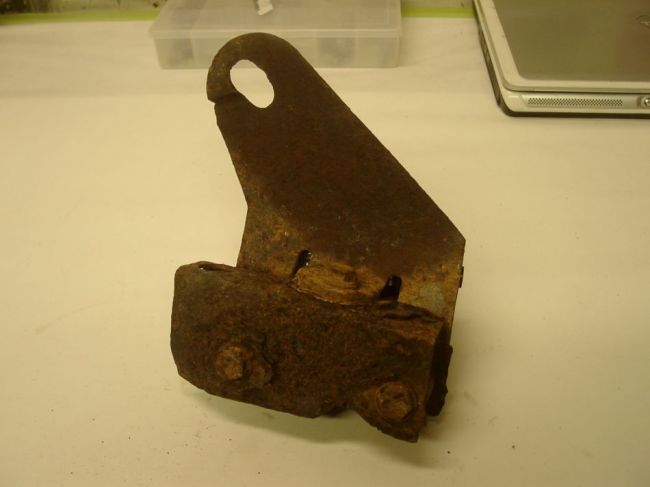
here is the other side of mine
looks like a big 'cupped' out area near the hole at the top
were these removed on arrival before selling
or were they left on the car?
sorry to be such a bother
iowa
[Blocked Image: http://www.surfacezero.com/g503/data/500/medium/2010_09_19_014_tie_down.jpg]
The scenerio goes like this:
- Somewhere on the assembly line, the tie down plates were installed. The installer grabbed two, some addition hardware if needed, and put them on the car. I think before the exhaust system was installed on a Mustang as access to the bolts is restricted.
- When the finished car was put on a truck or train, two chains were attached to the plates and tightened. The front was chained down via holes in the frame rails (per a former delivery driver).
- At a distribution point, the cars were placed on another truck to go to a specific dealer and chained down again.
- As part of dealer prep, the dealer was supposed to remove the tie down plates and return them to the assembly plant for reuse. We know that didn't happen with any discipline. I would think that cars sent overseas would retain the plates as returning them would not be cost effective.
Jim
Back to the "Coopers" - I was on my way across the street to my neighbors house last night (Giants baseball) when I noticed that my 1969 VW Baja also had Coopers on the front. They have been on the car over ten years, have at least 25,000 miles on them, been thru several trips into the Sierras, work great at 6 psi in the sand and show no signs of wear. There is not much weight on a VW front end. I mentioned this whole flap about Coopers to my neighbor and he stated he too, had Coopers on his 2003 Hyundai installing them in 2004, by choice. Are they the best tire? No. Are they the worst tire? No. Do they give a good service? Yes.
Jim
Women drivers are like that -
I have a set of Cooper P225/60R14 tires on my 66 hardtop semi-daily driver with style Steel Wheels and they give a good ride. They arn't fancy and as far as raised letters go, I am not one to give "free" advertising as a priority in selecting a product.
Jim
The two different sizes, as stated above, are sitting on a shelf next to my bead blasting cabinet waiting to be blasted and painted.
Jim
Being that I took off the "shorter" 8 1/4 inch style from my car, and my Shelby owner got the same style from his 66, that does not lend creedance to what you were led to believe. When ever, and where too, tie down plates were put on with the intent that they were to be returned from the dealer. And as I said, I don't have any idea where the 8 3/4 inch ones came from, if those are in fact the longer version.
Jim
There have been instances where the floor (actually it's the forward slope of the rear axle hump) reinforcement plates were not installed on factory GTs. The frame rail crush plate appears to be 100 percent present on factory dual exhaust cars in question.
Jim
You can "make" a GT from any "K" 65 built after March, 65 or any 66 "K". Other than crush plates that are added, everthing else that is a permanent alteration is a removal (aka hole). However, fenders can be a problem because the difference in hole placement for the pony, GT badge and the letters for Mustang. Everything else is a bolt on or tape, and I can fake the punched fog light wire holes in the radiator support very easily. Just make sure you punch the right size holes.
Jim
 Quote from cobraboyDisplay More
I can hear the groans already.
So just a quickie - have been reading all day and am still confused.
Can any part of the dual exhaust system including floor pan and rear frame rail reinforcements, brake pipe support brackets be used to identify a factory GT ? or can these be had by other option routes ?
Car is 1965 April 13R Dearborn fastback.
Everything else checks out, just wondered if any part of the exhaust is a pointer.
Thank you
The only thing I know of is the crush plate in the frame rails for the two rear exhaust brackets. The plate is only used on dual exhaust equipped cars including GT's and "K"s (whether the "K" was a GT or not).
Jim
I may be able to tell you what is, but not what is not (sounds cryptic). I removed a set from my Oct,66 San Jose build "K" car and they are 8 1/4 inches long. I have a second set that came from a March, 66 San Jose GT-350 which are the same. Both have square tops, both are the three bolt type (bent tab for the third), mine was painted semi-gloss black (maybe glossier), the Shelby's were Early-American rust. The interesting part is that the Shelby's set are both right hand plates. The installer gabbed "something" and put it on. Somewhere along the time line, the Shelby's owner got another pair but does not know the application. They are 8 3/4 inches long, three bolt and have round tops (about 3/4 inch radius). I also have a set from a March, 66 San Jose build that are the two bolt flat type. That statement will set off alarms. The car now speaks Australian.
Jim
And tell his lordship to keep his damn emptys off my front lawn.