Posts by Dan Case

    Color Code Information Wanted

    Ford 2100/4100 Carburetor “Support” (a.k.a. booster, cluster) Color Codes


    Mid 1960s support assemblies were marked with either one or two daubs of colored paint. Some of the late 1950s parts were partially dipped in dyes of different colors. The tubular passages from their tower like main bodies out to auxiliary venturi were targets for color code daubs. Each color they had could be used alone of in combinations with itself or other colors. The example below is the secondary “B” support in a new old stock C3OF-AJ model for most 1963½ HP289 Fairlane engines. The B supports received a single red daub on what would be the driver’s side tube of the car the carburetor was used in.

    The content cannot be displayed because you do not have authorisation to view this content.

    The “BA” support used in C4OF-AL carburetor assemblies received a red daub on both tubes. There were all kinds of colors and combinations; i.e. yellow on one side and black on the other. The one I can find no data on is the “M” support used in C4OF-AL carburetors. So far I have not found anybody that knows how they were marked. While the daubs on secondary supports often last until somebody solvent cleans the assembly the daubs on primary clusters usually got washed off pretty quickly, probably by fuel mist during choke operation.


    My question to the community is, does anybody have color pictures of a new old stock M support or have a used part with traces of paint remaining? I sure would like the information to complete my spread sheet on color codes on C4OF-AL, C4OF-AT, and early C5OF-L carburetors for 1964½-65 HP289 engines.


    Thanks for looking.

    Dan

    The most unusual one of these that I have seen is the Cougar one that a friend of mine bought many years ago. I have seen these Weber manifolds indexed both directions for the carburetors which changes the accelerator linkage setup. I knew a guy in the San Francisco area who had a cross ram? Weber manifold on the Honey West Cobra back in the 70's.

    -Fred-


    L-M offered COUGAR lettered aluminum engine goodies and they are all extremely rare now. If you know how many different items had COBRA lettering for the 1967 model year you know how many COUGAR lettered items there were. I have seen only one COUGAR 4-2V Weber carburetors intake for sale ever.

    The "cross ram" side draft systems were something Dean Moon's companies sold. Shelby American tested a XHP-260 engine with a side draft system and the system was deemed too complicated and too little benefit. Ford had been working on 48 mm and 58 mm down draft systems for a couple of years by that time and Cobras went 48 mm down draft style systems.

    Wanted To Buy Ford 4100 Series Carburetor Parts

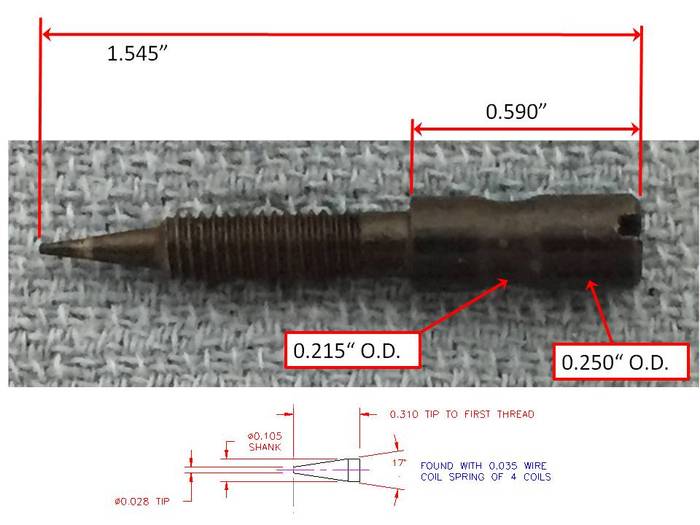
    2 each narrow angle idle mixture needle valve screws
    [Blocked Image: http://www.clubcobra.com/photopost/data…mall_needle.jpg]

    4 each 4 loop coil springs that go with the narrow angle idle mixture screws above (4 loop springs are rare, most 2100/4100 carburetors use 4½ loop springs)


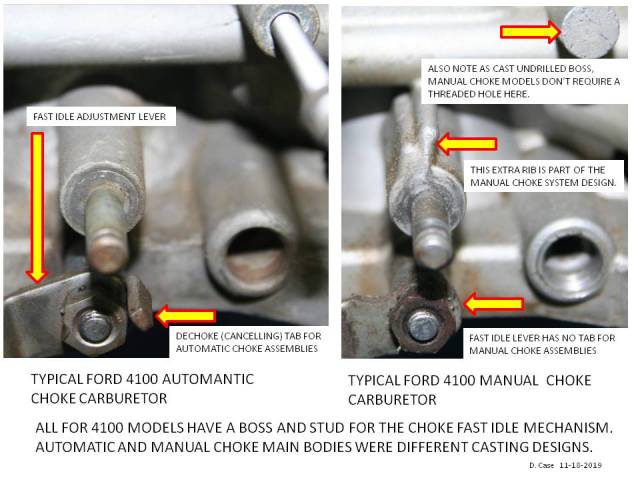
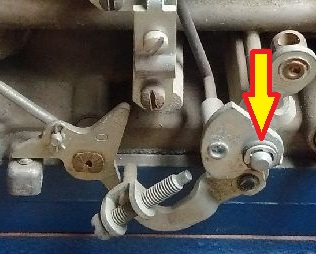
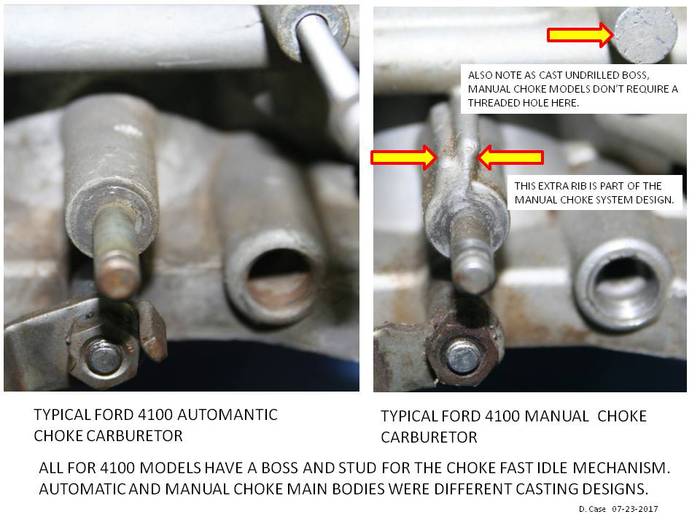
    2 each manual choke fast idle adjustment levers (different part than automatic choke applications) and long fast idle adjustment screws (different part than automatic choke applications)

    [Blocked Image: http://www.clubcobra.com/photopost/data…_and_Boss_2.jpg]
    [Blocked Image: http://www.clubcobra.com/photopost/data/3280/Fast_Idle_Lever.jpg]


    2 each fast idle cam distance pieces, plated steel version (looks like an odd thick flat washer)

    [Blocked Image: http://www.clubcobra.com/photopost/data…st_Idle_Cam.jpg]

    Thanks for looking.
    Dan

    [quote pid='1569' dateline='1572793731']

    Quote from C6ZZKGT


    Here is an Ebay auction for an NOS C3OZ 8592 A thermostat housing by Ebay member "cobranda" with a Buy-It-Now of $150.00:


    https://www.ebay.com/itm/1964-1-2-6…3IAAOSwlc9db7Ro

    -Fred-

    Please use caution with the sellers description as this housing only fits up to a time in 1965. This housing is for intake manifolds with a pocket in the manifold for the thermostat. If you try to use this housing with a thermostat on later manifolds without the thermostat pocket, you will break this housing.

    -Fred-


    It is actually a new old replacement stock (NORS) part made after 1978. Ford Motor Company owned and operated an aluminum foundry in Sheffield Alabama for decades making die cast aluminum pieces. Raw castings were shipped from the casting plant to other facilities for final machining and or assembly as required. After the plant in north Alabama plant closed, production was moved elsewhere. As molds wore the castings got increasingly poor in appearance. The solution was to tumble them with media to give them a texture like the part in this auction.

    Dan

    [/quote]

    The unfortunate thing is that the intake manifolds are not rare and are just about the lowest cost piece if you are trying to buy one part at a time to assembly a production Cobra or Ford accessory (there were many differences in parts for new Cobras versus over the counter kits) system. To come up with every single piece for a Cobra can be more costly that a genuine 1964-65 4-2V Weber carburetor system from the same time frame. Got a Fairlane, they required a special throttle linkage kit from Ford for this system. I have not seen one since 1980 when I sold the new old stock kit I once had. The standard Ford accessory parts are not easy either. Sooner or later most people trying to go "original" resort to hand making parts themselves or having somebody else do so based on pictures of Day 1 installations. In the case of a 1964-65 Cobra if somebody gives you an intake you still might have several thousand to maybe ten thousand dollars or more and lots of time before getting to the end of that journey.

    Dan

    PS The drawings for the intakes and Cobra installations were not done until late 1963. The production carburetors for Cobras are normally dated December 1963 or early 1964. Got Chrysler carburetors dated 1961-62, sorry too early for anything Cobra or Ford. Ford accessory system carburetors you might find can be dated between 1964 and 1967. Many were dated in 1965.

    Regarding C6FE cylinder head castings, in no particular order.


    Original 1960s castings are not as rare as you might think as Ford made many of them in at least two different versions of casting patterns. Assemblies wise out of the box from Ford and as contractors prepared them for Shelby American they were quite different. The other original race parts for either Group II sedans or GT40s engines are extremely rare in excellent condition.


    Cylinder head matched assemblies prepared by Mondello, Valley, and maybe Rogers for Shelby American in serial numbered matched sets that are still in very good to excellent condition are pretty rare.


    When vintage racing went from a few owners riding around on a pretty day to people running like a national championship was at stake in the late 1970s early 1980s lots of reproduction castings were made for the vintage racers. I talked to a man that advertised them in Hemmings Motor News® back then and he said he had PALLET LOADS of raw castings ready to machined and finished any way buyers wanted. Since then I believe somebody else has made reproductions. (That set of situations made me lose interest in any not traceable back to Ford or Shelby American.) In the early 1980s parts dealers wanted between $3,500 and $6,500 for a pair of new old stock assemblies as Ford sold them. If you wanted to get them fully race prepared you had to do so on your own. When the vintage race replicas hit the market new old stock pair 'value' dropped to not much more than a pair of new old stock HP289 heads. Good used pairs of C6FE head might have been found for less that $800.


    I cannot speak about all 1967 Group II Mustang or Cougars or later GT40 MKIs but at least some don’t want 1960s cylinder heads.


    One of the three Shelby numbered pairs I have purchased or traded for were from a GT40 race coupe owner that wanted a certain pair of modern aftermarket aluminum heads and $600 in trade. That was for Shelby set serial number 5. Joe Mondello’s shop prepared them for Shelby American new and Joe refreshed them for me in 2002. In our hour plus long discussion about my plans for them and how they were to be refreshed Mr. Mondello agreed that hardened exhaust seat inserts should be installed so he did so. We are using them in our red car.


    The typical want advertisements I see posted have been from people racing something in the UK or Europe.


    Us, Dan and Martha, we are using set serial 5 ex-GT40 in our red car. I have not damaged a 289 cylinder head ever even playing at 8,500 rpm in SFM5S142 so I am not concerned.


    PS To get the benefit of full race C6FE heads induction and exhaust systems are required to suit. Some of the Shelby Team heads have seriously enlarged exhaust ports that just any header won't match up to them.

    Regarding exhaust valve seat recession in cast iron cylinder heads, my 2 cents.

    Driven lightly to moderately most of the time I have never heard of any issues with iron cylinder heads and stock Ford valves. Some owners used lead free premium fuel in the 1960s and 1970s, I did from time to time but not exclusively. In period the common wisdom was use some leaded premium occasionally with unleaded fuel most of the time. Lead level content for preignition suppression and lead level content enough to protect the exhaust valves were different subjects. Said another way, you didn’t have to have so much lead in the system so as to produce chalk white insides of tail pipes to protect the valve train.

    Driven at 4,500 rpm and higher revolutions a minute for prolonged periods can under some circumstances cause dramatic recession with stock Ford valves in stock heads. This situation comes up in original Cobras during some long distance tours (750 to 1,300 miles in four days) with 3.77:1 differential gears and rear tires anywhere close to the O.E.M. tire diameter on 25.5 inches for most Cobras. 1965 GT350s with 3.89:1 gears also turn pretty fast on tours and during track days.
    In our red car, depending on exact rear tire diameter in use,

    90 mph is around 4,500 rpm± depending on tires used

    120 mph is around 6,000 rpm±

    132 mph is around 6,500 rpm±

    Engine heat wise five minutes at 6,000 rpm and above is a long time and I have done 30 minutes at a time hitting 8,000 rpm on the straights in open track events.

    We have participate in quite I think eight (8) long tours and there is almost always some spirited driving between 4,500 and 6,500 rpm for more than just short sprints. One of the owners we have toured with participated with have a very near stock engine developed progressively deteriorating performance during one of the western long distance high road speed events. By the end of the event the car would barely run. Upon inspection all the exhaust valve seats deeply recessed. The cylinder head castings and exhaust valves were both damaged.

    I am told by very experienced long term owners that using any brand or alloy of stainless steel or titanium exhaust valves is a solution to the problem. Having hardened exhaust seats installed will solve the problem even with stock 1960s Ford valves.

    We have a car with the valve train Ford installed in February 1964 except for lifters which I replaced at circa 50,000 miles. We use a lead substitute additive in it and have no fear of running it hard as long as I like. Sounds really great above 5,000 rpm. Our other car has modern stainless steel valves and hardened seats. We do not use lead substitute with it and I have no fear of running it as hard and long as I wish. We use to own 1965 MUSTANG GT350. I modified that engine internally including hardened seats and stainless steel valves. I often ran it 6,000 rpm and up on jaunts between towns and up to 8,500 rpm during play for miles at a time. Hardened seats and stainless steel valves were zero problem.

    Summary, from my prospective, with unleaded non-ethanol fuels.

    Engines to be used lightly with occasional short moderate sprints can probably go decades just fine in as built specifications.

    Engines to be used for extended periods of time under high loads and high revolutions per minute probably should be modified. Why risk degradation. (In 2016 we had the engine for a friend's car rebuilt. My friend will probably never run the car very hard or long at one time. I had hardened seats and nice stainless steel valves installed not for my friend but the future of the car. Maybe not in more standard Mustangs but in Cobras, 427 Cobras, and GT350s it is not all that rare for somebody to spend an awful lot for a show quality car and then have it suffer serious engine failure very soon after purchase. Several day tours or open track events find the weak links.)

    Engines with now very rare 1966-65 Shelby American racing cylinder head assemblies, why risk an issue. (You might just roll in and out of a trailer or go to the cars and coffee but the next owner might take the car to a race track or even SAAC convention open track event.)

    Engines with now ultra rare C6FE GT40/Group II cylinder heads from Ford or Shelby, why risk it. (Ditto, maybe not you but a subsequent owner might run the engine hard.)

    Dan